
In This Article
A heavy duty wire crate for escape artist dogs is a welded metal kennel built with thicker heavy gauge steel, reinforced door frames, double slide bolt latches, and tight bar spacing. Those upgrades stop powerful, anxious, or clever dogs from bending bars, popping latches, or squeezing out. It trades portability and folding convenience for raw strength.

Every escape artist has a signature move. Some lean on the door like a bouncer testing a velvet rope. Some work a bolt with the patient nose of a locksmith. The demolition crowd hooks a jaw around a bar and peels it outward like the lid of a sardine tin. A standard folding crate was designed for a calm dog who accepts the arrangement, and it was never meant to survive a negotiation with a dog who doesn’t.
That’s the gap this guide fills. Crate training works best when the crate is a den and not a battlefield, and the same references warn that leaving a dog to fight its way out can sour the whole experience. A crate that doesn’t fail is part of the training plan, not a substitute for it.
Below you’ll find seven real models, with the specs translated into plain English and the review sentiment summarized honestly. We also dig into heavy gauge steel, slide bolt latches, bar spacing, and what to do with a wire kennel for dogs that bend bars. One caveat before we start: roundups from several publishers agree that no crate is truly indestructible against every dog. The goal is to remove the weak points a standard crate hands to a determined one.
Quick Comparison: 7 Best Heavy Duty Wire Crates at a Glance
Specs and prices shift between sellers and listing updates, so treat the table as a research snapshot and confirm details on the current page.
| Crate | Steel / Tube Spec | Latch Setup | Approx. Size | Price Range | Best For |
|---|---|---|---|---|---|
| BOLDBONE 48 Inch Heavy Duty Crate | 20-gauge steel, ~0.5″ tubes | Double slide bolt latches | 48 x 31 x 35 in | $150-$300 range | Overall balance |
| LEMBERI 48 Inch Heavy Duty Crate | 20-gauge, ~0.8″ tubes | Dual latches, safety buckles | ~47 x 31 x 36 in | $150-$300 range | Bar benders |
| KOKOTANGS 48 Inch Heavy Duty Crate | 20-gauge, 0.5-0.6″ tubes | Multiple locks, double door | ~47.5 x 31.5 x 36 in | $150-$300 range | Strong large breeds |
| Hiwokk 48 Inch Heavy Duty Kennel | ~0.8″ square tubes | Heavy-duty safety latches | 48-inch class | $150-$300 range | Tighter budgets |
| PawHut Heavy Duty Double Door Crate (36 Inch) | Metal frame | Two front bolts, one top bolt | 36-inch class | $100-$200 range | Medium dogs |
| Amazon Basics Heavy Duty Stackable Kennel | Heavy-duty wire | Slide-bolt style | Several sizes | $150-$300 range | Brand-trust shoppers |
| MidWest iCrate Double Door (36 Inch) | Standard wire | Paw Block slide bolts | 36-inch class | Under $100 | Beginners, mild escapers |
Look at the table sideways and a pattern jumps out. The BOLDBONE 48 Inch Heavy Duty Crate, LEMBERI 48 Inch Heavy Duty Crate, and KOKOTANGS 48 Inch Heavy Duty Crate share a price band but differ in tube thickness, so your dog’s chewing style should break the tie. The MidWest iCrate Double Door is the cheapest entry, though reviewers agree it won’t survive a dog who has already bent a crate. The PawHut Heavy Duty Double Door Crate is the one to look at if a 48-inch behemoth won’t fit your home.
💬 Just one click — help others make better buying decisions too!😊
Top 7 Heavy Duty Wire Crates for Escape Artist Dogs: Expert Analysis
1. BOLDBONE 48 Inch Heavy Duty Crate — latches your dog’s nose can’t reach
The headline feature is the pair of double slide bolt latches, which is where most escape artists find their first opening. The frame uses 20-gauge steel with reinforced tubes of about 0.5 inches, and roundups describe the latches as recessed so a nose or paw can’t easily get purchase. In practice, that means the crate resists the two classic attacks at once: bar-bending and door-working.
Listings put it near 58 pounds, with locking swivel casters and a removable tray with a leak-proof pan. That weight is a feature, because a light crate gets shoved across the floor by a panicking dog. The casters, once locked, let you move it for cleaning without tipping.
On paper, this is the sensible default for a large dog who needs real security but doesn’t have a history of destroying steel. Reviewers consistently report that big breeds like Great Danes and Belgian Malinois stay contained, and roundups cite average ratings around 4.6 stars across thousands of reviews. Treat those figures as aggregated sentiment.
Pros:
- ✅ Double slide bolt latches resist nose and paw work
- ✅ Sturdy 20-gauge frame with reinforced tubes
- ✅ Locking casters make cleaning and moving easier
Cons:
- ❌ Heavy and awkward to lift or store
- ❌ Reviewers mention similar-looking parts during assembly
Price sits in the $150-$300 range, so check the current price, and it earns the value verdict for most large-dog households.

2. LEMBERI 48 Inch Heavy Duty Crate — thickest tubes of the bunch
If your dog treats bars as a gym machine, the tube thickness matters most. This model is listed with roughly 0.8-inch steel tubes, a 500-pound load rating, dual doors, dual latches with safety buckles, and lockable wheels. Thicker tubing is much harder for a jaw to wrap around, and that is exactly the leverage a bar-bender needs.
Listings in the 47-by-31-by-36-inch range suggest a big footprint, and weights quoted by different roundups vary widely, from the high 50s into the 80s. Check the listing for your size. A heavier build resists walking and flexing, but you will not move it casually, so decide on its permanent spot before you order.
The review pattern is consistent. Roundups frame it as a pick for dogs with a history of breaking latches, bending bars, or hurting themselves in escape attempts. That’s a recommendation of design intent, not a lab test, so keep expectations honest. A truly obsessive dog can still find a seam.
Pros:
- ✅ Very thick tubes resist bending and leverage
- ✅ Dual latches plus safety buckles on each door
- ✅ Strong load rating for giant, heavy dogs
Cons:
- ❌ Bulky footprint, measure doorways first
- ❌ Expensive to ship and move
Expect the $150-$300 range, and the value verdict is strong if bent bars are your specific problem.
3. KOKOTANGS 48 Inch Heavy Duty Crate — four casters, double-door flexibility
The standout here is placement flexibility. Four lockable casters, a double-door layout, and a removable floor grate with a slide-out tray let you position the crate and clean it without wrestling it. The frame is 20-gauge steel with tubes in the 0.5-0.6 inch range, a sweet spot between the BOLDBONE 48 Inch Heavy Duty Crate and the beefier LEMBERI 48 Inch Heavy Duty Crate.
Size is roughly 47.5 by 31.5 by 36 inches, so it suits large breeds who need to stand and turn around comfortably. One reviewer-roundup caveat is worth noting: the caster brakes can slip under aggressive force from a large dog. That is a real-world detail the spec sheet won’t tell you. If your dog is a pusher, put the crate against a wall or corner so the casters can’t travel.
Review sentiment in roundups is positive, with owners of escape-prone dogs reporting few bent bars or broken latches after months of daily use. Take that as encouraging, not as a guarantee.
Pros:
- ✅ Four lockable casters for easy repositioning
- ✅ Removable grate and tray simplify cleaning
- ✅ Mid-thickness tubes balance strength and weight
Cons:
- ❌ Caster brakes can slip under heavy pushing
- ❌ Large footprint needs generous floor space
At around the $150-$300 range, it’s a good value for powerful but not truly destructive dogs.
4. Hiwokk 48 Inch Heavy Duty Kennel — budget-friendly square tubing
This one is the budget pick in several roundups, and the feature worth knowing is its square steel tubing of about 0.8 inches. Square tubes present flat faces, which are harder for teeth to grip than round bars. They also tend to feel more rigid under sideways force.
The listing mentions heavy-duty safety latches and lockable wheels in the 48-inch class. As with any budget-friendly steel crate, the details that matter most are the ones you verify yourself: how the door aligns, whether the latch seats fully, and whether the welds look clean when the box arrives. A door that sags a few millimeters is an invitation.
Reviewers in roundups put the average rating around 4.5 stars, which is solid, though review pools for lesser-known brands can be smaller and less stable. Read recent reviews for assembly and quality-control comments before you buy.
Pros:
- ✅ Square steel tubing resists gripping and flexing
- ✅ Lockable wheels for easier movement
- ✅ Often priced below better-known rivals
Cons:
- ❌ Smaller review history than leading models
- ❌ Door alignment needs a careful first inspection
Expect the $150-$300 range, and the value verdict is good for budget-minded owners who will inspect the crate on arrival.
5. PawHut Heavy Duty Double Door Crate (36 Inch) — three bolts, mid-size footprint
Not every escape artist weighs 90 pounds. For medium dogs, the headline here is the three-bolt arrangement: two slide-bolt latches on the front door plus a central slide-bolt on the top hatch. Every opening has a lock, which closes the “roof door” loophole that many crates leave.
Four caster wheels with locking brakes keep it mobile in a 36-inch frame. The smaller size also means shorter spans between bars, and shorter spans flex less. For a 40-to-60-pound dog, that matters more than headline gauge numbers.
Roundups and retail listings describe it as a secure double-door option, but public review data is thinner than for the 48-inch giants. Be honest with yourself about your dog’s strength. A medium Malinois or a determined pit mix may out-muscle a 36-inch frame faster than a sleepy Lab ever would.
Pros:
- ✅ Two front bolts and a top-hatch bolt
- ✅ Locking casters on a manageable 36-inch frame
- ✅ Shorter bar spans resist flexing
Cons:
- ❌ Too small for large or giant breeds
- ❌ Less public review data than larger models
Price sits in the $100-$200 range, so check the current price, and it is a solid value for medium dogs.
6. Amazon Basics Heavy Duty Stackable Kennel — familiar brand, stackable design
The standout is the stackable design. If you have two dogs, or a crate plus a spare for travel or boarding, stacking saves floor space. It’s also a recognizable brand with accessible customer service, which counts when a latch or tray goes missing.
One roundup lists a price range of roughly $150 to $290 depending on size, which fits the heavy-duty class. Details vary by size and version, so verify gauge, latch style, and bar gap on the exact listing. That is the one place I’d tell you to slow down. “Heavy duty” is a marketing phrase, and the spec page is the truth.
The practical read: this is a fit for a dog who is strong and mildly escape-prone, not a proven champion against a persistent bar-bender. If your dog has already defeated a standard wire crate, step up to a thicker-tubed model instead.
Pros:
- ✅ Stackable layout saves floor space
- ✅ Trusted brand with accessible customer service
- ✅ Several size options for different dogs
Cons:
- ❌ Specs vary by size, so verify each listing
- ❌ Less proven against true bar-benders
Expect roughly the $150-$300 range, with a moderate value verdict for owners who value convenience.
7. MidWest iCrate Double Door (36 Inch) — Paw Block latches on a budget
The feature worth the headline is the Paw Block slide-bolt latch, designed so a dog can’t slide the bolt open from the inside. A friend-of-a-friend “Houdini Lab” story in one roundup credits it with stopping latch-escapes. That’s anecdote, but it points at a real design choice.
Still, this is standard wire with rounded corner clips and a divider panel. Several roundups say plainly that determined chewers can bend standard wire, and that a dog who has already bent crates or has severe separation anxiety will outgrow it. One source recommends stepping up to a heavy-duty steel crate like the LEMBERI 48 Inch Heavy Duty Crate or the BOLDBONE 48 Inch Heavy Duty Crate in that case.
So who is it for? A mild escaper, a young dog still in training, or a first crate you can fold flat. It also makes a useful baseline for comparing bar spacing.
Pros:
- ✅ Paw Block latches resist inside-out bolt work
- ✅ Folds flat with a handy divider panel
- ✅ Very affordable entry price
Cons:
- ❌ Standard wire can bend under sustained jaw pressure
- ❌ Not suited to severe anxiety escapers
Price is typically under $100, and the value verdict is excellent for mild cases and poor for serious ones.
How to Choose a Heavy Duty Wire Crate for Escape Artist Dogs
Picking the right crate is less about brand and more about matching weak points to your dog’s habits. Work through these steps in order.
- Diagnose the escape method first. Bending bars, popping latches, chewing, and pushing the whole box around each need a different fix. A latch fix does nothing for a bar-bender.
- Prioritize thicker tubes over fancy extras. For jaw-benders, tube diameter and steel thickness matter more than wheels or trays.
- Check every door, including the roof. A crate with one strong latch and one weak top hatch is only as secure as the hatch.
- Measure the dog, then the doorway. The dog needs room to stand, turn, and lie flat, and 48-inch crates won’t pass through every hallway.
- Inspect bar spacing against your dog’s head and paws. Gaps should be smaller than the dog’s head and offer no tooth-sized grip points.
- Plan for weight and placement. A heavier crate resists being pushed, and a wall behind it helps even more.
- Verify warranty and return terms. Because “escape-proof” is a claim, not a certification, a good return policy is your safety net.
Rover’s roundup of heavy-duty options makes the same sober point, noting that even the best steel crates can’t be called 100 percent escape-proof. You can read that in their heavy-duty dog crate guide. Use it as a reality check, not a reason for despair.

Heavy Gauge Steel: What the Numbers Actually Mean
Gauge is the most confusing number on a listing. In wire and sheet terms, a lower gauge number means thicker metal. A 7- or 9-gauge wire is beefy, while 20-gauge is relatively thin, and that’s why the labels sound contradictory at first read.
Add a second wrinkle: the listings above use “20-gauge” together with tube diameters like 0.5 or 0.8 inches. These describe different parts of the build, such as wall thickness versus outer width, and sellers don’t always define them. One retailer even argues that “indestructible” crates use thicker welded bars of roughly 14 to 16 gauge, which shows how loosely the vocabulary gets used. Read it as a vendor claim, not a standard.
So what should you actually look for? For a dog who bends bars, prioritize heavy gauge steel with thicker tube diameter, welded joints, and reinforced corners. Roundups frequently say that anything thinner than 20-gauge can be bent by a determined dog around 60 pounds. Look for sellers who publish tube diameter and weight, because heavier crates generally mean more metal.
The spec sheet won’t tell you this, but weight is a good proxy. A 48-inch crate under 40 pounds is probably not the fortress its title implies.
Slide Bolt Latches: The Weakest Link in Any Crate
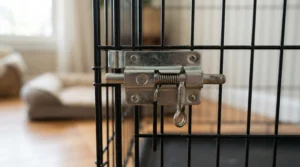
A crate is only as strong as its door latch. Standard slide bolt latches can be nudged open by a clever nose or paw, and that learned behavior escalates quickly once a dog discovers it works.
Better crates attack this in layers. Double slide bolt latches on each door remove the single-failure point common to cheaper crates. Recessed housings keep a nose from getting leverage. A “Paw Block” style design, like the one on the MidWest iCrate Double Door, prevents the bolt from being slid from inside. The PawHut Heavy Duty Double Door Crate adds a bolt on the roof hatch, so no opening is left unsecured.
Even so, the cheapest upgrade is often hardware you add. A small locking carabiner or quick link clipped through the latch and frame can slow a clever dog dramatically. Use metal hardware designed for the load, and check it regularly for wear.
Think of latches the way you’d think of a front door at night. A deadbolt helps, but the door, frame, and hinges also matter. If one slide bolt is all that stands between your dog and the hallway, add a layer.
Bar Spacing: Safety and Escape Math
Bar spacing does two jobs at once. For small dogs and puppies, it’s a safety issue, because a gap larger than the dog’s head or paw is a trap. For escape artists, it’s a leverage issue, because bigger gaps give jaws and paws something to grab.
Spacing varies widely. One roundup notes that a MidWest-style crate uses a gap near 37.5 millimeters, which is fine for dogs over about 10 pounds, while a small Amazon Basics folding model is cited at roughly 15 millimeters, far safer for toy puppies. The practical rule from those guides is to choose a gap clearly smaller than your dog’s head and, when in doubt, size down on the gap and size up on the crate.
For a strong adult, think about paws and teeth too. Roundups on heavy-duty crates highlight smaller ventilation holes that a tooth or jaw can’t hook into. Enclosed panels reduce bar-grabbing but also reduce airflow, which is a trade you should weigh in warm climates.
Bar spacing is also a puppy problem. If you’re buying for a growing dog, a divider panel lets you keep the footprint small while the tubing stays secure.
Wire Kennel for Dogs That Bend Bars: A Problem-to-Solution Guide
A wire kennel for dogs that bend bars needs a plan, not just a purchase. Here are the common failure patterns and the fixes that match them.
Problem: the bars bow outward near the door. The door seam is the weak point because it has the least reinforcement. Choose a crate with a reinforced door frame, thicker tubes such as the LEMBERI 48 Inch Heavy Duty Crate, and a double-latch layout.
Problem: the dog works the corner until it spreads. Corners fail when welds are poor or when panels are held by clips. Prefer welded corners over clip-together panels, and inspect them weekly.
Problem: the crate crawls across the room. A moving crate gets leverage against furniture. Heavier models like the BOLDBONE 48 Inch Heavy Duty Crate resist walking, and locked casters or a wall at the back help.
Problem: the dog is hurting itself. If you see torn nails, bloody muzzles, or broken teeth, stop. A stronger crate keeps the dog contained, but it does nothing for panic. See the safety section below and speak with your veterinarian.
Problem: the latch gets nosed open. Layer it with a metal carabiner and a recessed double bolt.
Apply these in order of cost: placement first, hardware second, a new crate third.
Practical Setup Guide: Your First 30 Days With a Heavy Duty Crate
A secure crate won’t help if the dog hates it. Treat the first month as a campaign, not a drop-off.
Days 1-3: Build the den. Assemble the crate in a main living area, lock the casters, and leave the door open. Feed meals inside. Add a firm bed that can’t be shredded easily, and remove any soft items that could be ingested.
Days 4-10: Short closed-door sessions. Close the door for a few minutes while you’re in the room, then open it before any fussing starts. Build duration slowly. Releasing a dog during a tantrum teaches that tantrums work.
Days 11-20: Practice departures. Leave the room for short periods, then the house. Exercise the dog beforehand, because a tired dog is a calmer one.
Days 21-30: Maintain and inspect. Check latches, welds, and the tray every week. Wipe the coating, tighten bolts, and look for new bends.
Common first-month mistakes include leaving the dog too long too soon, using the crate as punishment, and never inspecting hardware. Municipal animal services give plain guidance on handling escape behavior in this escape-prevention resource from Austin Animal Services, which is worth a read.
Real-World Scenarios: Which Crate Fits Which Dog?
Specs get real when you attach them to a household. Here are three profiles and a sensible match for each.
The apartment renter with a 55-pound shepherd mix. She has a small living room and a dog who bends bars at the door seam. The PawHut Heavy Duty Double Door Crate fits a 36-inch footprint, while the three bolts handle latch games. If the dog proves stronger than expected, the step-up path is a 48-inch crate.
The family with a 100-pound Great Dane. Space is generous, and the dog’s sheer mass is the threat. The BOLDBONE 48 Inch Heavy Duty Crate gives weight and double slide bolt latches. The LEMBERI 48 Inch Heavy Duty Crate is the upgrade if bars start to flex.
The first-time owner of a young, mouthy husky. Budget is tight and the dog is clever but not yet destructive. The MidWest iCrate Double Door with Paw Block latches is a reasonable starting point, provided the owner agrees to upgrade at the first sign of bending. The Hiwokk 48 Inch Heavy Duty Kennel is the middle path once the dog grows.
Notice how the right answer depends on budget, environment, and use frequency. A daily workday crate deserves a bigger investment than an occasional boarding kennel.
Heavy Duty Wire Crate vs. Alternatives: Which Type Wins?
Wire isn’t the only option. Plastic airline crates, furniture-style wooden crates, and premium aluminum or welded-steel “indestructible” crates all compete for the escape artist’s budget.
| Crate Type | Escape Resistance | Airflow | Portability | Best For |
|---|---|---|---|---|
| Heavy duty wire (e.g., BOLDBONE 48 Inch Heavy Duty Crate) | High for most dogs | Excellent | Low | Large, strong, clever dogs |
| Standard wire (e.g., MidWest iCrate Double Door) | Low to moderate | Excellent | Fold-flat | Mild escapers, puppies |
| Plastic airline crate | Moderate; chewing can breach | Fair | Good | Travel, calmer dogs |
| Furniture-style wooden crate | Low | Limited | Fair | Looks-first homes |
| Premium aluminum or welded “indestructible” crate | Very high | Varies | Low | Extreme escapers |
The table makes a clear case: heavy duty wire sits in the middle of the price-to-performance curve. It gives most of the security of premium builds with far better airflow and visibility than enclosed designs, which matters for dogs who panic when they can’t see you. For dogs who defeat even thick steel, premium builds such as high-anxiety aluminum crates exist, though they cost several times as much and may not be sold on Amazon. For everyone else, a well-chosen KOKOTANGS 48 Inch Heavy Duty Crate hits the sweet spot.
Long-Term Cost and Maintenance: What Your Crate Really Costs
The sticker price is only the first number. Over several years, the cheapest crate is often the most expensive one.
Consider a $60 standard wire crate that gets bent in month three, replaced with another, then another. Two replacements cost more than a single heavy duty purchase, before you count chewed baseboards or vet bills for nail and tooth injuries. A durable crate in the $150-$300 range, used daily for five or more years, costs pennies per use.
| Crate Tier | Typical Price Range | Likely Lifespan for a Strong Dog | Value Verdict |
|---|---|---|---|
| MidWest iCrate Double Door | Under $100 | Short for benders | Good only for mild cases |
| PawHut Heavy Duty Double Door Crate | $100-$200 range | Medium | Strong for mid-size dogs |
| Hiwokk 48 Inch Heavy Duty Kennel | $150-$300 range | Long if inspected | Strong budget heavy-duty pick |
| BOLDBONE 48 Inch Heavy Duty Crate | $150-$300 range | Long | Best all-round value |
| LEMBERI 48 Inch Heavy Duty Crate | $150-$300 range | Long | Best for bar benders |
Looking at the table, the real saving comes from avoiding repeat purchases, not from chasing the lowest tag. Maintenance is cheap: wipe the coating, tighten hardware, replace worn clips, and look for rust where the tray sits. A quick monthly inspection extends life more than any accessory.
Safety First: When the Crate Isn’t the Real Problem
Here’s the uncomfortable truth. Many escape artists aren’t bad dogs or strong dogs. They’re frightened dogs.
Veterinary and welfare sources describe escape attempts, frantic chewing, and vocalizing as typical signs of confinement anxiety or separation-related distress, not disobedience. The American Animal Hospital Association’s separation anxiety handout goes further, advising owners not to confine a dog with separation anxiety in a crate because the animal may hurt itself trying to escape. You can read the AAHA client handout on separation anxiety for the full guidance.
What does this mean for a heavy duty crate buyer? If your dog shows extreme panic in confinement, a stronger crate alone is the wrong tool. Warning signs include bloody gums, torn nails, drooling, and attempts that begin the moment you pick up your keys. Talk with your veterinarian or a credentialed behaviorist about a plan, which may include desensitization and sometimes medication.
A heavy duty crate remains useful for dogs who are bored, adolescent, or mildly stressed, and for safe travel or recovery. Just be honest about which dog you have.
Common Mistakes When Buying a Crate for an Escape Artist
Most failures are predictable. Avoid these.
- Trusting the word “indestructible.” Marketing isn’t a test. Look for specs and recent reviews.
- Buying too big. An oversized crate lets a dog build momentum and gives more room for panic pacing.
- Ignoring the roof and side doors. One weak opening undoes the rest.
- Skipping assembly checks. Loose bolts and misaligned doors create the gaps dogs exploit.
- Leaving collars or tags on. Dangling gear can snag on bars. Remove them while crated.
- Using the crate as punishment. It poisons the whole training plan.
The expert shortcut is simple. Match the crate to the escape method, verify the hardware, and keep inspecting.
FAQ: Heavy Duty Wire Crates for Escape Artist Dogs
❓ What steel thickness stops a dog from bending crate bars?
❓ Are slide bolt latches secure enough for a clever dog?
❓ What size crate should I buy for a strong large dog?
❓ Can a heavy duty crate fix separation anxiety?
❓ Should I secure a heavy duty crate to a wall or floor?
Conclusion: The Right Heavy Duty Wire Crate for Escape Artist Dogs
Escape artists aren’t a character flaw, they’re a design brief. The best heavy duty wire crate for escape artist dogs combines heavy gauge steel, doubled slide bolt latches, and bar spacing too tight for paws and teeth, and then asks you to do the human part: place it well, train gently, and inspect it often.
For most large, strong dogs, the BOLDBONE 48 Inch Heavy Duty Crate is the best all-round value. If bars are what your dog attacks, the LEMBERI 48 Inch Heavy Duty Crate brings the thickest tubing. The KOKOTANGS 48 Inch Heavy Duty Crate suits owners who want flexible placement, and the Hiwokk 48 Inch Heavy Duty Kennel helps when budget is the constraint. Medium dogs can look at the PawHut Heavy Duty Double Door Crate, brand loyalists at the Amazon Basics Heavy Duty Stackable Kennel, and first-timers with mild escapers at the MidWest iCrate Double Door.
Remember that no crate is perfect, and a panicking dog needs a vet, not just steel.
Recommended for You
- [Add your blog post link 1]
- [Add your blog post link 2]
- [Add your blog post link 3]
Disclaimer: This article contains affiliate links. As an Amazon Associate, I earn from qualifying purchases. If you purchase products through these links, we may earn a small commission at no additional cost to you.
✨ Found this helpful? Share it with your friends! 💬🤗
