
In This Article
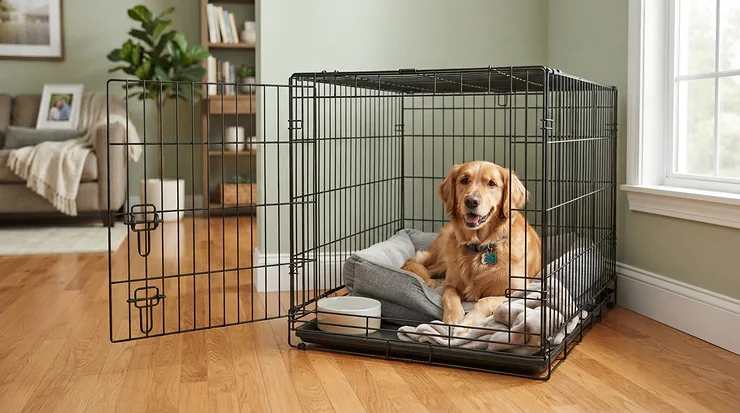
The single door vs double door wire crate question comes down to access. A single door model opens only at the front end. A double door model adds a second door on the side, so you can load, feed, or retrieve your dog from two directions. Both fold flat and share the same basic steel build, and the American Kennel Club keeps a useful overview of crate types and sizing if you’re starting from zero.

It sounds like a trivial checkbox. It isn’t. One extra door changes where the crate can live and how it feels to open at 6 a.m. with a coffee in your other hand. Pick wrong, and you’ll be dragging a steel cage away from the wall every morning like the world’s most awkward dance partner.
This guide compares seven real crates, three single door and four double door. It digs into the things listings barely mention: door swing clearance, latch placement, and floor footprint. Everything here comes from spec sheets, retailer listings, and aggregated review sentiment. No product was hands-on tested, and I’ll flag where review data runs thin. Prices appear as ranges because they move constantly.
The short version? If the crate has a permanent home, especially a corner, single door usually wins on simplicity and strength. If you’re still hunting for the right spot, or your furniture migrates, the second door buys real flexibility. Let’s prove it.
Quick Comparison: 7 Wire Crates at a Glance
Before the deep dive, here’s the whole field on one screen. Price ranges are approximate and size-dependent, so check current price before you buy.
| Product | Doors | Size Focus | Price Range | Best For |
|---|---|---|---|---|
| MidWest iCrate Single Door | Single | 18″ to 48″ lineup | Roughly $25-$110 | Calm dogs, fixed crate spot |
| Amazon Basics 36-Inch Double Door | Front + side | 36″ x 23″ x 25″ | Roughly $40-$60 | Medium dogs, flexible placement |
| Carlson Secure Single Door | Single | 24″ (24″ x 18″ x 20.5″) | Roughly $30-$60 | Small breeds, secure latching on a budget |
| Amazon Basics 30-Inch Single Door | Single | 30″ | Roughly $30-$50 | Light use, tight budgets |
| MidWest Ultima Pro Double Door | Front + side | Five sizes | Roughly $60-$110 | Heavier-duty everyday use |
| Pet Gear The Other Door | Front + side | Multiple sizes | Roughly $50-$100 | Homes that move the crate often |
| Precision Pet Great Crate Two Door | Front + side | 36″ (50-70 lb dogs) | Roughly $90-$100 | Escape-prone dogs |
Looking at the table, the cheapest crates are mostly single door models, and the premium picks are mostly double door. The price gap is real but modest at equal sizes. Amazon Basics 36-Inch Double Door proves a second door doesn’t have to cost much. Buyers who prize toughness over flexibility should look at Precision Pet Great Crate Two Door first.
💬 Just one click — help others make better buying decisions too!😊
Top 7 Wire Crates: Expert Analysis
Each pick below gets honest analysis built on real specs and aggregated review sentiment. Where I couldn’t verify a deep review pool, I say so.
1. MidWest iCrate Single Door — the most proven single door layout
This is the crate others get measured against. The reason is refreshingly dull: it behaves the same way every time you fold, unfold, or latch it.
The lineup runs from an 18-inch toy-breed size up to a 48-inch giant-breed model, with a slide-bolt latch, leak-proof pan, and divider panel in most sizes. The 24-inch version measures roughly 23.6 x 16.7 x 19.3 inches and suits dogs up to about 25 pounds. The 48-inch is listed for dogs in the 90-110 pound range. The divider matters more than it sounds, because one crate can shrink for a puppy and grow with the adult.
Here’s the analysis. With one door and fewer moving parts, this is a natural base for a simple single door wire kennel setup where the crate lives in one permanent spot. What most buyers overlook is the flip side: one door means exactly one way in, so the room has to cooperate.
Reviewers on retail listings rate it around 4.7 stars. They praise fast setup and value, and the recurring complaint is wire that’s thinner than heavy-duty rivals.
Pros:
- ✅ Slide-bolt latch and leak-proof pan included
- ✅ Divider panel grows with your puppy
- ✅ Wide size range from toy to giant
Cons:
- ❌ Thinner wire than heavy-duty competitors
- ❌ Single door limits placement in tight spaces
Expect roughly $25-$110 depending on size; check current price. Verdict: excellent value for calm dogs with a fixed crate spot.
2. Amazon Basics 36-Inch Double Door — best-reviewed side-access value
If the iCrate is the dependable sedan, this is the crowd-pleasing hatchback. It earns its popularity with sensible features and few surprises.
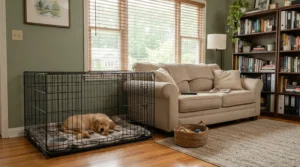
The 36-inch size measures 36 x 23 x 25 inches and weighs about 22 pounds. It has front and side doors, a removable tray, a divider, and a carry handle. Roundups position this size for medium breeds. In practice, two doors mean you can tuck one side against a wall and use whichever door faces open floor. Twenty-two pounds is manageable, though you’ll feel it on a staircase.
Based on the spec comparison, the second door is cheap insurance if you haven’t settled on a spot, or if you rearrange furniture seasonally. It’s the clearest argument in the single door vs double door wire crate debate for people who value options.
Review sentiment is strong. The listing I found showed roughly 4.7 stars across well over 25,000 ratings, and it held a top rank in the basic crate category at the time of that snapshot.
Pros:
- ✅ Front and side doors for flexible placement
- ✅ Divider panel and removable tray included
- ✅ Folds flat with a carry handle
Cons:
- ❌ Not built for determined escape artists
- ❌ Second door adds another latch to maintain
Roughly $40-$60 range, depending on seller and timing. Verdict: the best-value double door for average dogs.
3. Carlson Secure Single Door — multi-point locking in a compact build
Carlson’s headline is its multi-point locking system, a security detail that many cheap crates skip.
The small size measures about 24 x 18 x 20.5 inches. It has one front door, steel construction, and a limited 90-day manufacturer’s warranty listed by at least one retailer. Multi-point locking matters because a door pinned at several spots is harder for a clever dog to nudge loose than one held by a single bolt. The warranty is short, so treat it as a minimum, not a promise of longevity.
The analysis is straightforward. This is a smart fit for small breeds and for owners who value locking over frills, especially as a single door wire crate for corner placement where only one door is ever needed. Roundup reviewers call it a best-value pick but note the wire is on the thin side. That’s fine for polite dogs and risky for chewers.
Retail ratings are encouraging. One 24-inch listing showed about 4.5 stars across roughly 300 reviews.
Pros:
- ✅ Multi-point locking system for added security
- ✅ Compact footprint suits small breeds
- ✅ Solid value for a steel crate
Cons:
- ❌ Thin wire gauge per roundup reviewers
- ❌ Short 90-day limited warranty
Roughly $30-$60 depending on size; check current price. Verdict: a quiet bargain for small, well-behaved dogs.
4. Amazon Basics 30-Inch Single Door — lightest budget single door
This crate wins on weight and price, the two things bargain hunters notice first.
At about 16.6 pounds, it’s easy to carry, and roundup specs show tight wire spacing around 15 mm. That tight spacing is a plus for small mouths and paws. It’s positioned for small breeds and light use, which is honest marketing. If you’re crating a 15-pound terrier for overnight sleeping, you don’t need armor plating.
Here’s what to weigh. A single door with a basic latch is easy to understand and easy to clean, and it makes a tidy simple single door wire kennel for a bedroom. But “budget” means you shouldn’t expect the sturdy frame of pricier models. For a boisterous adolescent, the analysis flips fast.
Review data is mixed in quantity. One shopper summary expressed satisfaction with the single door model’s price. A 36-inch Amazon Basics single door listing showed roughly 4.3 stars from a small pool of ratings, so treat sentiment as encouraging but limited.
Pros:
- ✅ Very light and easy to carry
- ✅ Tight wire spacing suits small mouths
- ✅ Budget-friendly entry point
Cons:
- ❌ Not suited to heavy chewers or escape artists
- ❌ Single door limits placement flexibility
Roughly $30-$50 range; check current price. Verdict: perfect for a small, calm dog and a thin wallet.
5. MidWest Ultima Pro Double Door — heavy-duty frame with tool-free fold
The Ultima Pro is MidWest’s step up from the iCrate, aimed at owners who want a sturdier everyday crate.
Retail listings label it heavy-duty and offer five sizes. Roundup coverage notes it sets up and folds down with no tools, which matters because a crate that’s annoying to collapse tends to stay assembled forever. Double doors give you the same flexible access as other side-door crates, and the heavier build addresses the most common complaint about budget wire: flex.
Based on the spec comparison, this is the sensible middle ground. It costs more than bargain crates but less than furniture-style options, and the heavier frame should translate into fewer wobbles over years of daily use. Dogs that lean, scratch, or shove at the door benefit most.
One caution. The retailer listing I checked showed a modest number of ratings, so I can’t point to a deep review pool here. Treat the heavy-duty claim as a spec-sheet advantage, not a long-term verdict.
Pros:
- ✅ Heavier-duty build than entry-level crates
- ✅ Tool-free setup and fold-down
- ✅ Double door access for flexible placement
Cons:
- ❌ Costs more than basic double doors
- ❌ Smaller review pool on retailer listings
On the listings I found, common sizes sat in the $60s, with larger sizes costing more; check current price. Verdict: a worthwhile upgrade for stronger or more active dogs.
6. Pet Gear The Other Door — built-in wheels for a crate that moves
Most crates are furniture. This one wants to be a wheelbarrow.
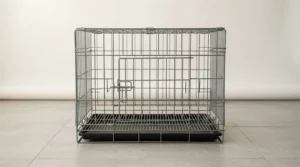
Roundup reviewers single out its built-in wheels as the feature that sets it apart. It also has double doors, folds flat, and includes a fleece pad. Wheels turn a two-person shuffle into a one-person glide, which matters if you move the crate between rooms, vacuum under it, or shuttle it to the car.
The analysis cuts both ways. For households that rearrange, the combination of wheels and double doors is genuinely clever. But wheeled bases can shift on slick floors, and every moving part is something to inspect over time. If your crate stays put in one corner forever, you’re paying for mobility you won’t use. In that case a single door model usually offers more rigidity for less money.
Sentiment is limited in my sources, which mention the wheels but offer little verified review data. Read current customer reviews before committing.
Pros:
- ✅ Built-in wheels simplify moving the crate
- ✅ Double doors add placement flexibility
- ✅ Folds flat for storage
Cons:
- ❌ Wheels add parts to inspect over time
- ❌ Wheeled bases can shift on slick floors
Pricing varies widely by size and seller, with a mid range of roughly $50-$100; check current price. Verdict: great for movers, unnecessary for stay-puts.
7. Precision Pet Great Crate Two Door — 5-point locking for escape artists
Some dogs treat a latch as a puzzle. This crate answers with five points of locking.
The 36-inch version is listed for pets in the 50-70 pound range and features a 5-point locking system. In practice, more lock points distribute stress across the door, so a dog that pushes at one corner meets resistance at several spots. That’s the right feature set for a determined dog, and it pairs well with two doors since both openings get secure closures.
Here’s what to weigh. This is a premium-feeling pick in a category where most crates compete on price. If your dog has already rattled a standard slide-bolt open, spending more for stronger latching is cheaper than replacing a damaged crate. If your dog is mellow, you’re paying for security you won’t use.
I couldn’t verify a large pool of customer reviews for this specific listing, so judge it on specs. Cross-check recent reviews before ordering.
Pros:
- ✅ 5-point locking system for stronger closure
- ✅ Two doors for flexible placement
- ✅ Sized for 50-70 pound dogs
Cons:
- ❌ Priciest option in this lineup
- ❌ Limited verified review data in my sources
Roughly $90-$100 on the retailer listing I found; check current price. Verdict: worth it for escape-prone dogs, overkill for easy ones.
How to Choose Between a Single Door and a Double Door Wire Crate
The direct answer: choose single door if the crate has one permanent home, and choose double door if you need flexibility. Here are the steps, in order. Sizing guidance from PetMD’s crate-size guide backs up step one.
- Measure your dog first. A crate should let your dog stand, turn around, and lie down comfortably. Bigger isn’t kinder; an oversized crate invites accidents in one corner.
- Pick the spot before the crate. Where it will live decides whether a second door earns its keep. A fixed corner favors a single door, while a shifting layout favors two.
- Measure the door swing. Open-door space is part of the crate’s real size. We’ll unpack this below.
- Inspect the latch design. Latches that lock at multiple points resist rattling better than a lone hook.
- Match wire strength to temperament. Heavy chewers and escape artists need sturdier steel than a calm senior.
- Buy for the adult dog, and use the divider. This is cheaper than upgrading sizes later.
- Check current price and reviews. Prices shift, and recent reviews catch design changes that older ones miss.
Door Swing Clearance: The Measurement Nobody Takes
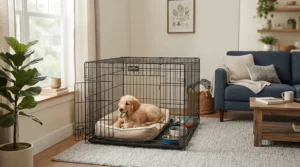
Door swing clearance is the open floor you need in front of a door for it to open fully. Nearly every buyer forgets it, and it’s the reason crates end up cockeyed in hallways.
A front door typically hinges at the side and swings outward. The arc is roughly the width of the crate’s end panel. On a 36 x 23 x 25 inch crate, a 23-inch door sweeping a quarter circle claims about 2.9 square feet of extra floor. That’s my own back-of-envelope arithmetic, not a manufacturer spec, so measure your actual crate. Some designs also need a small lift to clear locking tabs. For example, one MidWest product page describes lifting the door to clear its LapLocks before swinging it open, so vertical room matters too.
Here’s where the single door vs double door wire crate decision gets practical. A double door doesn’t reduce door swing clearance, because each door still sweeps its own arc. What it does is give you a choice. If the front arc is blocked by a couch, you open the side door instead. A single door has no plan B, so its one arc must stay clear.
Test it with painter’s tape before buying. Mark the crate’s footprint plus a quarter-circle at the door end, then live with the tape for a day. You’ll know within hours whether the layout works.
Latch Placement: Why Where the Bolt Sits Matters
Latch placement affects security, convenience, and even how often you curse in the morning.
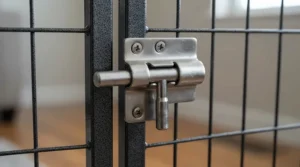
Security first. One buyer’s guide suggests favoring slide-bolt latches that lock at both top and bottom of the door, since a single hook latch is easier for a determined small dog to rattle open. Roundup reviewers also warn that some thinner crates have latches that don’t secure properly, so a heavy-duty latch on a flimsy frame isn’t a guarantee.
Now convenience. Latch placement determines which side you must reach. If the latch sits on the side facing a wall, you’ll be fumbling blind. On a double door model, the front and side doors each carry their own latches, which doubles your options and doubles the hardware to check.
Here’s a simple routine. Before placing any crate, confirm that every latch you plan to use faces open space. Then press each latch firmly and tug the door to verify it seats fully. Check again monthly, because bent bolts and misaligned doors creep up slowly.
For escape artists, the sturdier answers are crates like Precision Pet Great Crate Two Door with its 5-point system, or Carlson Secure Single Door with multi-point locking. Calm dogs do fine with the standard bolts on MidWest iCrate Single Door.
Floor Footprint: What Each Layout Really Costs You in Space
The floor footprint of a crate is what the metal covers. Its working footprint also includes the room you need to use the doors.
Do the math on a 36 x 23 inch crate. That’s 828 square inches, or about 5.75 square feet. Add the roughly 2.9 square feet a fully swung 23-inch door claims, and the working footprint climbs to around 8.6 square feet. For a smaller crate like the 24-inch MidWest iCrate Single Door at roughly 23.6 x 16.7 inches, the crate itself covers about 2.75 square feet.
Here’s the key insight. A single door and a double door crate of the same size have identical metal footprints. The difference is flexibility in the working footprint. With two doors you can push one long side against a wall and use the other. With one door, the open end must always face usable floor.
Small apartments should weigh this carefully. A 36-inch crate in a narrow hallway may technically fit and still be unusable once the door arc is counted. If floor space is tight, a smaller size with a divider, or a single door model in a dedicated nook, often beats a larger double door crate that forces constant rearranging.
Single Door Wire Crate for Corner Placement: A Natural Match
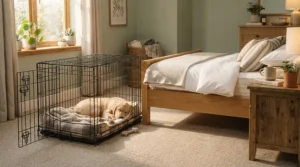
A single door wire crate for corner placement is one of the strongest arguments for staying simple. Corners are naturally boxed in on two sides, so a second door would face a wall and go to waste.
Here’s the layout that works. Slide one long side along one wall and the back end against the adjoining wall, leaving the door end open to the room. The door swings into free floor, the latch is easy to reach, and the crate stays out of foot traffic. One brand’s crate guide makes the same point, suggesting a single door design suits owners with a designated crate corner.
This is where MidWest iCrate Single Door and Carlson Secure Single Door shine. With fewer hinges and latches, there’s less to loosen, and the dog gets a cozy den-like space with walls on two sides.
There are two caveats. First, make sure the crate isn’t jammed so tight that you can’t slide the tray out for cleaning. Second, leave a few inches behind the crate for airflow and to keep the dog from chewing baseboards or cords. If your “corner” ever changes, remember you can’t add a second door later.
A Simple Single Door Wire Kennel: When Less Hardware Wins
A simple single door wire kennel is the minimalist’s answer, and minimal isn’t a downgrade. Fewer doors mean fewer latches to bend, fewer gaps to flex, and fewer parts to explain to a house-sitter.
Think of it like a cast-iron skillet versus a gadget-laden air fryer. The skillet isn’t flashier, but it rarely breaks. For calm dogs in a settled home, Amazon Basics 30-Inch Single Door offers a no-nonsense box at a friendly price. MidWest iCrate Single Door adds divider and pan features while staying simple.
The trade-offs are real. A single door limits you when furniture moves, and the cheapest versions use thinner wire. Keep expectations matched to your dog’s temperament. A shy senior will treat a basic crate like a cozy bedroom, while a powerful adolescent may treat it like a challenge.
Cost-wise, simple models often sit at the lower end of the price spectrum. Combined with the divider trick for growing puppies, that makes them some of the most economical ways to start crate training. Just plan the floor space and door swing clearance first.
Real-World Scenarios: Matching Crates to Real Homes
Specs tell part of the story. Scenarios tell the rest. These are hypothetical profiles built to show the reasoning.
Scenario 1: The studio apartment with a small terrier. Floor space is precious, the dog is polite, and the crate will sit in one corner beside the bed. A single door wire crate for corner placement fits perfectly. Carlson Secure Single Door gives secure locking in a compact size. If budget is tight, Amazon Basics 30-Inch Single Door works for a calm small breed.
Scenario 2: The family room with a medium dog and shifting furniture. The couch moves for holidays, the kids’ play mat expands and contracts, and the crate has to adapt. Amazon Basics 36-Inch Double Door lets you open whichever side faces free floor. The extra door is cheap insurance against a rearranged room.
Scenario 3: The senior dog with stiff joints. Easy entry and soft bedding matter more than raw strength. A veterinarian-reviewed crate selection guide recommends easy-entry crates for older dogs. A double door model gives you a side door that may make loading a sore dog less awkward, and MidWest Ultima Pro Double Door adds a sturdier frame for everyday use.
The pattern is clear: match the door count to the space, not to the dog’s size alone.
✨ Ready to Compare Current Prices?
🔍 Take your crate shopping to the next level with these carefully selected picks. Click any highlighted product name to check current pricing and availability. A well-chosen crate helps you build a calm, confident routine your dog will love!
Setting Up Your Wire Crate: A First-30-Days Guide
Buying the right crate is half the job. Setting it up well is the other half.
- Unfold and inspect. Make sure every panel clip is seated and the door aligns. Misaligned doors are the number one cause of “this latch doesn’t work” frustration.
- Seat the tray fully. Slide the pan all the way in so edges can’t snag paws.
- Position with the door swing in mind. Use the painter’s tape trick, then check each latch faces open space.
- Set the divider for the dog’s current size. Your dog should have room to stand, turn, and lie down. Move the divider as your puppy grows.
- Introduce gradually. Leave the door open at first, feed meals near the crate, and add short closed sessions slowly.
- Run a weekly check for the first month. Tug each door, test each latch, and look for bent wire or loosened clips.
Common first-month mistakes include buying an oversized crate, skipping the divider, and placing the crate where the latch side faces a wall. Fix those three and you’ll avoid most headaches. If your dog shows frantic distress in the crate, pause and consult a qualified trainer rather than pushing through.
Single Door vs Double Door Wire Crate: The Head-to-Head Breakdown
Time for the direct comparison. One crate maker’s single versus double door comparison leans the same way many owners do: single door for a designated spot and simplicity, double door for flexibility and special behavioral needs.
| Factor | Single Door | Double Door |
|---|---|---|
| Access | One front opening | Front and side openings |
| Placement flexibility | Needs open space at the door end | Can use whichever door faces free floor |
| Corner use | Excellent | Good, but one door may face a wall |
| Hardware to maintain | One door, one latch set | Two doors, two latch sets |
| Typical cost | Often lower | Often modestly higher |
| Best For | Fixed spots, calm dogs, simple setups | Shifting layouts, shared spaces, flexible homes |
The table shows why neither option is universally better. Single door wins on simplicity, cost, and corner efficiency, while double door wins whenever the crate’s location might change. If you’re unsure, remember the logic: you can latch a second door shut and ignore it, but you can’t add a second door to a single door crate later.
In terms of security, both designs can be strong when properly built. The weak spot is usually wire gauge and latch quality, not door count. A well-latched Precision Pet Great Crate Two Door beats a flimsy single door every time, and a solid MidWest iCrate Single Door beats a poorly built double door.
Common Mistakes When Buying a Wire Crate
Learn from other buyers’ pitfalls, because they repeat constantly.
Buying too big. An oversized crate invites using one end as a bathroom. Buy the right adult size and use a divider.
Ignoring door swing clearance. The crate fits the spot, but the door can’t open. This is the classic hallway fiasco.
Assuming a second door fixes a bad location. A double door crate wedged in a corner wastes its extra door. Choose the layout first.
Buying the thinnest wire for a strong dog. Roundup reviewers note thin wire is a recurring weakness in budget crates. Calm dogs can live with it, while powerful dogs may bend it.
Overlooking latch quality. Flimsy bolts undermine even a sturdy frame.
Forgetting the floor footprint beyond the metal. Add the working space for doors, trays, and cleaning.
Skipping reviews and price checks. Models change, and recent reviews reveal design tweaks. Always check current price and current feedback.
Long-Term Cost and Maintenance
A wire crate is a multi-year purchase, so think total cost of ownership, not just sticker price.
| Tier | Example | Price Range | Value Note |
|---|---|---|---|
| Budget | Amazon Basics 30-Inch Single Door | Roughly $30-$50 | Best for calm small dogs |
| Value | Amazon Basics 36-Inch Double Door | Roughly $40-$60 | Strong reviews, flexible doors |
| Mid-range | MidWest Ultima Pro Double Door | Roughly $60-$110 | Sturdier frame for daily use |
| Premium | Precision Pet Great Crate Two Door | Roughly $90-$100 | Heavy locking for escape artists |
Prices are approximate and change often, so check current price. The pattern is that paying more mostly buys sturdier steel and stronger locking, not extra convenience. If your dog is gentle, the value tier probably delivers the best cost-per-year. If your dog tests every latch, spending more upfront can prevent replacement costs.
Maintenance is light. Wipe the pan regularly, inspect clips and welds monthly, and keep an eye out for rust where wire meets wire, especially near moisture. Tighten or replace anything that loosens. Consistent small checks extend a crate’s useful life far more than any premium feature.
FAQ: Single Door vs Double Door Wire Crates
❓ Is a double door crate worth the extra money?
❓ Can a single door crate work in a corner?
❓ How much space should I leave in front of a wire crate door?
❓ Are double door crates less secure than single door ones?
❓ Which size crate should I buy for a growing puppy?
Conclusion: Pick the Door Count That Fits Your Home, Not the Hype
The single door vs double door wire crate decision is really a question about space and flexibility. If your crate has a permanent corner, single door options like MidWest iCrate Single Door and Carlson Secure Single Door deliver simplicity and value. If you want choices, Amazon Basics 36-Inch Double Door is the best-reviewed way to buy them cheaply. If your dog is strong or crafty, MidWest Ultima Pro Double Door or Precision Pet Great Crate Two Door buys sturdier construction. And if you’re constantly moving the crate, Pet Gear The Other Door and its wheels may earn their keep.
Whatever you choose, measure door swing clearance, think hard about latch placement, and count the floor footprint beyond the metal. Those three details decide whether a crate feels effortless or exhausting. Check current price and recent reviews before you buy, because both change.
Recommended for You
- [Add your blog post link 1]
- [Add your blog post link 2]
- [Add your blog post link 3]
Disclaimer: This article contains affiliate links. As an Amazon Associate, I earn from qualifying purchases. If you purchase products through these links, we may earn a small commission at no additional cost to you.
✨ Found this helpful? Share it with your friends! 💬🤗
