
In This Article
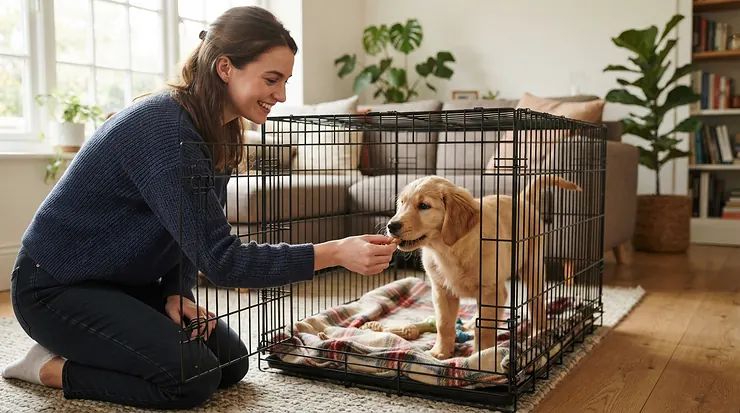
A double door wire crate for large breed puppies is a folding steel kennel with two entrances, typically front and side, plus a divider panel and slide-out tray. It’s built so one crate can shrink around a squirmy eight-week-old now and stretch around a 100-pound adult later.
That last part is the whole game. A giant breed puppy can gain weight at a rate that feels personally insulting to your floorboards. Buy a crate sized for the dog you have today and you’ll be shopping again in three months. Buy one sized for the dog you’ll have at two years old, skip the divider, and your puppy gets a cavernous bedroom with a corner to pee in. Neither ends well.
So here’s the plan. I dug through retailer listings, spec sheets, and roundup reviews to find seven real crates that fit the brief, from budget 48-inch workhorses to a 54-inch extra large double door dog crate for the truly enormous. I haven’t handled any of them. What follows is analysis built on published specs and aggregated review sentiment. Where the evidence is thin, I’ll say so rather than bluff.
If you’re new to crate work in general, the American Kennel Club’s step-by-step crate training guide is a solid companion read. It notes that training can take as little as a day or stretch to several months. Budget your patience accordingly.
Quick Comparison: 7 Double Door Wire Crates at a Glance
Here’s the lineup before we get into the weeds. Door counts are “front and side” unless noted. Check current prices on the listings, since they move constantly.
| Crate | Size Class | Door Setup | Best For |
|---|---|---|---|
| MidWest Solution Series XX-Large | 54 x 37 x 45 in | Double door | Giant adults (Great Dane territory) |
| MidWest LifeStages 48-Inch | 48 in class, 90-110 lb dogs | Front and side | Most large breed puppies |
| MidWest Ultima Pro 48-Inch | 48 in class | Front and side | Strong, chew-prone puppies |
| Amazon Basics 48-Inch | 48 x 30 x 32.5 in | Double door | Straightforward value |
| BestPet 48-Inch | 48 in class | Double door | Tight budgets |
| FDW 48-Inch | 48 in class | Double door | Calm puppies, budget buyers |
| BOLDBONE 48-Inch | 48 in class | Dual doors | Escape artists |
Notice how many rows sit in the 48-inch class. That’s no accident: it’s the sweet spot where a growing large breed lands before giants graduate to 54 inches. The tradeoff runs from the MidWest Solution Series XX-Large, which buys you headroom for a giant, to the Amazon Basics 48-Inch, which saves money and sacrifices almost nothing for a calm puppy. If your pup already treats furniture as a personal enemy, skip straight to the MidWest Ultima Pro 48-Inch or the BOLDBONE 48-Inch.
💬 Just one click — help others make better buying decisions too!😊
Top 7 Double Door Wire Crates for Large Breed Puppies: Expert Analysis
1. MidWest Solution Series XX-Large — the biggest wire option for giants
When your puppy’s parents are the size of a loveseat, this is the crate you grow into. It measures about 54 x 37 x 45 inches, which gives a Great Dane or Mastiff room to stand, turn, and sprawl without folding like a lawn chair.
On paper, that height matters as much as the length. Giant breeds carry their heads high, and a 45-inch ceiling means no hunching. The double door layout pairs well with front and side access, so you can park it in a corner and still reach your dog. Plan on a two-person lift when assembling or relocating, because crates this size aren’t graceful to carry.
Reviewers of the extra-large MidWest line commonly praise ventilation and room, and one roundup calls it big enough for Great Danes. I couldn’t verify a deep pool of independent reviews for this exact listing, so check current review totals before you buy. This is a crate for a giant breed puppy you’re confident will stay giant.
Pros:
- ✅ Roomy enough for true giant adults
- ✅ Tall interior prevents hunched posture
- ✅ Double doors give flexible placement
Cons:
- ❌ Bulky to move and store
- ❌ Overkill for a large breed that tops out near 70 pounds
Price sits in the premium tier, so check current price. For a Mastiff-type buyer, the value verdict is easy: you only buy this once.
2. MidWest LifeStages 48-Inch — the grow-with-me divider favorite
This is the crate most large breed puppy parents end up with, and for good reason. It runs 48 inches long by 30 wide and is rated for dogs in the 90-110 pound range.
The included divider panel is the feature that earns its keep. Early on, you section off just enough room for your puppy to stand, turn, and lie down, which keeps accidents from becoming a lifestyle. As your dog grows, you slide the divider back until it disappears. The leak-proof pan and secure latch round out a thoughtful package.
Reviewer sentiment is notably strong: the Chewy listing sits around 4.7 stars across roughly 1,500 reviews, which is a meaningful sample. Buyers consistently note the easy fold-and-carry setup. The weak spot is wire thickness; a determined chewer can find leverage.
Pros:
- ✅ Divider panel adjusts for growth
- ✅ Front and side doors for flexible placement
- ✅ Large, consistently positive review base
Cons:
- ❌ Standard gauge won’t stop a dedicated chewer
- ❌ Weighs enough to be awkward to move
Expect roughly a $130-$160 range. For most households, the value verdict is a clear yes.
3. MidWest Ultima Pro 48-Inch — thickest wire in the MidWest family
If the MidWest LifeStages 48-Inch is the dependable sedan, this is the one with the reinforced frame. The brand describes the Ultima Pro as its strongest, thickest-gauge crate, designed for powerful dogs and frequent travelers.
It measures about 49.3 x 29.8 x 32.3 inches and features the front and side door wire kennel layout, a divider, and folding construction that needs no tools. Detachable handles are a small thing until you’re hauling it to a vet visit. What the spec sheet won’t tell you is how it behaves at 3 a.m., but heavier wire generally means less flex when a 70-pound adolescent leans on the door.
Retail listings put satisfaction around 4 out of 5 stars, a notch below the 4.7s above. That’s worth knowing: the premium buys durability, not universal delight. The review pool is smaller, so I’d weigh it with care.
Pros:
- ✅ Heavier wire resists bending and prying
- ✅ Front and side doors plus divider included
- ✅ Folds flat for travel and storage
Cons:
- ❌ Costs noticeably more than standard-gauge crates
- ❌ Ratings trail the LifeStages line
Price lands around $150-$240 depending on size and seller. The verdict: pay it only if your puppy treats crates as an escape-room challenge.
4. Amazon Basics 48-Inch — the no-drama value pick
Sometimes the plain option wins. This double door crate measures roughly 48 x 30 x 32.5 inches and comes with a removable tray and a divider panel.
The spec list is short and honest: double doors, a tray, a divider, and straightforward assembly. That’s everything a calm large breed puppy needs and nothing it doesn’t. One heavy-duty roundup ranked it a top pick among 48-inch crates, though I couldn’t confirm current review counts, so look at the live listing.
Who is it for? First-time owners with an easygoing puppy who sleeps through the night and respects boundaries. Who should skip it? Anyone whose last dog bent a crate door like a paperclip.
Pros:
- ✅ Divider and tray included
- ✅ Two doors for flexible setup
- ✅ Familiar, easy-to-replace brand
Cons:
- ❌ Not engineered for escape artists
- ❌ Fewer reinforcements than heavy-duty rivals
It sits in the budget-to-mid tier, so check current price. The value verdict is strong, as long as your puppy isn’t a chewer.
5. BestPet 48-Inch — the budget option that still checks the boxes
Budget doesn’t have to mean barebones. This foldable 48-inch crate offers double doors, a divider, and a removable tray at a price that leaves room in the budget for the bed, bowls, and chew toys you’ll need anyway.
I saw it listed around the mid-$60s at a major retailer, with ratings in the mid-4-star range. That’s an encouraging signal, though the sample is smaller than the MidWest listings. The trade-off is straightforward: lighter construction typically means more flex and noise when a boisterous puppy bounces off the walls.
For a giant breed puppy likely to hit 100 pounds, I’d treat this as a stepping-stone crate rather than a forever home. For a large breed puppy topping out around 70 pounds, it may last indefinitely.
Pros:
- ✅ Very affordable for a 48-inch crate
- ✅ Double doors and divider included
- ✅ Folds flat for storage
Cons:
- ❌ Lighter build may flex under stress
- ❌ Smaller review pool than bigger brands
Look for pricing under $100. As a value pick for a calm puppy, it’s hard to argue with.
6. FDW 48-Inch — the thrifty double door for gentle pups
Another budget contender, the FDW 48-inch crate delivers a double door, removable tray, and divider panel. One roundup labels it a solid budget option for puppies and calm dogs, which is a refreshingly honest way to describe a crate.
That qualifier matters. “Calm dogs” is the operative phrase; this isn’t the crate for a puppy with a talent for demolition. Instead, think of it as training wheels. If you’re trying crate work for the first time and want to find out whether your dog even likes it, a lower-cost crate limits your downside.
Independent review data is thin for this specific model, so I’m not going to pretend otherwise. Check the live listing for current review counts and read the one-star reviews first. They tell you where the crate actually fails.
Pros:
- ✅ Double door and divider at a budget price
- ✅ Removable tray simplifies cleanup
- ✅ Folding design stores easily
Cons:
- ❌ Best suited to gentler dogs
- ❌ Limited independent review data
Pricing falls in the budget tier, so check current price. The verdict: fine for starters, risky for chewers.
7. BOLDBONE 48-Inch — escape-proof ambition for powerful puppies
This one is aimed squarely at anxious, strong, or destructive dogs. Listings highlight heavy-duty steel, dual doors, removable trays, and locking wheels, and one roundup claims roughly ten minutes of assembly and a 4.7 rating.
Let’s separate marketing from meaning. Wheels are genuinely useful: rolling a crate across the living room beats dragging it. Locking casters keep it from drifting when a puppy lunges. But phrases like “indestructible” belong to the manufacturer, not to a verified test.
If you’ve got a giant breed puppy with separation anxiety, a sturdier frame matters because anxious dogs push on doors relentlessly. Still, a crate won’t fix anxiety, and I’d pair any heavy-duty model with proper training and a vet conversation.
Pros:
- ✅ Reinforced build for powerful dogs
- ✅ Dual doors and wheels for easy repositioning
- ✅ Removable trays for cleanup
Cons:
- ❌ Costs more than standard wire crates
- ❌ “Escape-proof” claims are marketing, not guarantees
It sits in the mid-premium tier, so check current price. Value verdict: worthwhile for proven escape artists, unnecessary for everyone else.
Top 7 Side by Side
| Crate | Footprint (L x W x H) | Build Note | Price Range | Best For |
|---|---|---|---|---|
| MidWest Solution Series XX-Large | 54 x 37 x 45 in | Heavy-duty double door | Premium (check current price) | Giant adults |
| MidWest LifeStages 48-Inch | 48 x 30 in | Divider, leak-proof pan | $130-$160 | Most large puppies |
| MidWest Ultima Pro 48-Inch | 49.3 x 29.8 x 32.3 in | Thickest MidWest wire | $150-$240 | Chewers |
| Amazon Basics 48-Inch | 48 x 30 x 32.5 in | Divider, removable tray | Budget-to-mid (check current price) | Calm puppies |
| BestPet 48-Inch | 48-inch class | Foldable, divider | Under $100 | Tight budgets |
| FDW 48-Inch | 48-inch class | Divider, tray | Budget (check current price) | Gentle starters |
| BOLDBONE 48-Inch | 48-inch class | Heavy-duty, wheels | Mid-premium (check current price) | Escape artists |
Read this table by temperament, not price. The BestPet 48-Inch and FDW 48-Inch save money for puppies that behave, while the MidWest Ultima Pro 48-Inch and BOLDBONE 48-Inch earn their premium only if your dog tests boundaries. The MidWest LifeStages 48-Inch remains the best middle path, and the MidWest Solution Series XX-Large is a size decision more than a quality decision.
Crate Placement: Where Your Puppy’s Crate Actually Belongs
Crate placement is the least glamorous decision you’ll make and one of the most consequential. A great crate in a bad spot becomes a puppy prison; a decent crate in the right spot becomes a bedroom.
Start near you. For the first few weeks, put the crate in or beside your bedroom at night. Puppies settle faster when they can hear you breathe, and you’ll hear the 2 a.m. whimper that means “I need to go out.” Daytime placement works best in a social room, like the corner of the living room, where family traffic is steady but not chaotic.
Use front and side access to your advantage. This is where a front and side door wire kennel quietly shines. Push one side against a wall and you still have a working door facing the room. Tuck the crate into an alcove, and the side door lets you reach in for cleanup without dragging the whole thing out. With front and side access, you can also stage meals on one door and exits on the other.
Avoid the danger zones. Keep the crate away from radiators, direct sunlight, drafty doors, and the kitchen’s heat. A large breed puppy overheats faster than you’d expect, and wire offers no insulation.
Mind the floor. A hard floor under a heavy crate is fine, but slick surfaces let a bouncing puppy slide it around. A rubber-backed mat solves that and adds comfort. Treat crate placement as a living decision: revisit it every month or two as your puppy matures and your household routine shifts.

Your First 30 Days: A Practical Setup Guide
Here’s the playbook the product listings never provide.
Days 1-3: Build positive vibes. Set up the crate with the divider positioned so your puppy has just enough room to stand, turn, and lie down. Toss treats inside. Leave the door open. The goal is simple: the crate predicts good things.
Days 4-10: Short closures. Close the door for a few minutes while you’re in the room. Reward calm. If whining starts, wait for a pause before opening. Rewarding the noise teaches the wrong lesson.
Days 11-20: Build duration. Extend the time in small steps and mix up short and long stretches so your puppy never learns a predictable countdown. Keep in mind that bladders limit everything. Whole Dog Journal advises that a puppy shouldn’t stay crated more than two to four hours at a time during the day, and adults no more than six to eight.
Days 21-30: Overnight and alone. Move toward full nights, with a potty trip before bed and another at the first stirring. Crate your puppy for short, supervised absences before you attempt a workday.
Maintenance: Wipe the tray weekly, check latches monthly for bent wire or loose fittings, and slide the divider back as your puppy grows. Common first-month mistakes include moving the divider too early, using the crate as punishment, and skipping potty breaks. Avoid all three and you’re ahead of most owners.
Real-World Scenarios: Matching Crate to Household
Let’s translate specs into three hypothetical households.
The first-time Labrador family. A family with two kids and a Lab puppy wants something that grows with the dog without breaking the budget. The MidWest LifeStages 48-Inch wins: its divider handles the puppy stage, the front and side layout fits a corner, and its strong review base reduces buyer’s-remorse risk. If money is tighter, the BestPet 48-Inch is a reasonable stand-in for a calm pup.
The apartment Mastiff puppy. A single owner in a two-bedroom apartment brings home a Mastiff puppy that’ll exceed 100 pounds. Floor space is precious, but so is headroom. The MidWest Solution Series XX-Large is the honest fit, though the owner should measure the intended spot twice. Buying a 48-inch crate now and replacing it at six months is the costlier path.
The chewing, anxious German Shepherd. A household has a German Shepherd puppy with a flair for destruction. Here the MidWest Ultima Pro 48-Inch or BOLDBONE 48-Inch makes sense, ideally alongside trainer guidance on separation anxiety.
Match the crate to the dog’s temperament, not just its eventual size. The cheapest crate becomes expensive if it gets bent in week three.
✨ Don’t Miss These Exclusive Deals!
🔍 Take your crate shopping to the next level with these carefully selected products. Click on any highlighted item to check current pricing and availability. These picks will help you create a safe, comfortable den your growing pup will love!
How to Choose a Double Door Wire Crate for Large Breed Puppies
Follow these steps and you’ll avoid most regrets.
- Estimate adult size first. Large breeds start around 55 pounds and giant breeds exceed 99, so plan for the finished dog, then use the divider for today’s puppy.
- Measure your puppy. Retailer guidance suggests measuring back length and height, then adding 3-5 inches for a current ideal size.
- Insist on a divider panel. Without one, a big crate gives your puppy a bathroom corner.
- Check the door layout. Front and side doors give you far more room to arrange the crate in your home.
- Match gauge to temperament. Calm puppies thrive in standard wire; chewers need heavier builds.
- Inspect latches. A flimsy latch is the failure point, not the wire.
- Plan for storage and travel. Folding crates save space but weigh more at larger sizes.
An extra large double door dog crate is only a good purchase if it fits your door frames, your floor space, and your car. Measure those before you click buy.
Front and Side Door Wire Kennel: Why Two Doors Beat One
A single-door crate isn’t wrong, but it’s rigid. A front and side door wire kennel gives you geometry.
Consider a living-room corner. With a single front door, the crate must face the room, which limits how you can tuck it away. With front and side access, you can rotate the crate to hug a wall while keeping an entrance open. That matters more than it sounds when you’re sliding a 50-pound puppy in and out dozens of times a day.
Two doors also help with training. You can feed your puppy at one door and use the other for potty-trip exits, which helps build predictable routines. For cleaning, the side door lets you slide the tray out without wrestling the whole crate.
The cost? Slightly more latches to check and, occasionally, a small price premium. For most owners, front and side access is worth it. If you’re comparing an extra large double door dog crate against a cheaper single-door model, weigh how often you’ll shift the crate’s position. If the answer is “constantly,” buy the second door.

Wire Crates vs. Heavy-Duty Alternatives: What Changes?
Wire isn’t your only option. Whole Dog Journal’s roundup of collapsible crates concludes that a wire crate is the best option for most families and dogs, thanks to low cost, size range, and decent durability. For dogs that destroy wire or soft crates, it recommends the Impact Collapsible Dog Crate, a high-grade aluminum model that comes in a 54-inch size but is heavy enough to be difficult to transport.
| Feature | Wire Crate | Heavy-Duty Steel | Aluminum (Impact Collapsible Dog Crate) |
|---|---|---|---|
| Ventilation | Excellent | Good | Moderate |
| Portability | Folds flat | Heavier, often wheeled | Heavy but collapsible |
| Durability | Standard | High | Very high |
| Cost | Lowest | Mid-premium | Premium |
| Best For | Most puppies | Escape artists | Extreme chewers |
For a typical large breed puppy, wire wins on price, airflow, and flexibility. Steel and aluminum earn their place only when a dog has actually defeated a wire crate. Buying heavy-duty “just in case” usually means paying for weight and cost you’ll never use. The BOLDBONE 48-Inch sits in the middle, offering reinforced steel at a lower cost than aluminum, while the Impact Collapsible Dog Crate is the pick when nothing else survives.
Giant Breed Puppy Growth: What It Means for Crate Choice
A giant breed puppy isn’t just a bigger puppy. It’s a different growth curve, and that shapes everything about the crate.
Veterinary sources describe dogs above 99 pounds as giant breeds and note that their growth plates close later, sometimes not until around 18 months, compared with roughly 12 months in smaller dogs. Canine Arthritis Resources also highlights that slow, steady growth supports joint health, which is why large breed growth formulas exist.
What does this mean for your crate? Three things.
First, rest matters. Veterinary guidance emphasizes that sleep is important for growing large breed puppies, so the crate should be a genuine retreat, not a punishment zone.
Second, don’t treat the crate as exercise management. Growing joints need controlled, low-impact activity, not hours of confinement punctuated by wild play. Large breeds are typically fully grown around 18 months, and giants can take until 24.
Third, surfaces matter. A slick tray or hard wire floor is hard on joints, so add a supportive bed or mat. For any giant breed puppy, pairing the crate with a vet-approved feeding and exercise plan matters more than the crate brand.
Common Mistakes When Buying a Crate for a Large Breed Puppy
Buying only for adult size. A cavernous crate with no divider invites accidents and weakens the “den” instinct. Always use the divider.
Choosing price over temperament. A bargain crate that gets bent in week three isn’t a bargain. Match build to behavior.
Ignoring your floor plan. Measure the space, the doorway, and the car. A 54-inch crate that won’t fit through the hall is a very expensive sculpture.
Skipping the door layout. Without front and side access, your crate placement options shrink dramatically.
Treating the crate as a babysitter. Even the best double door wire crate for large breed puppies fails if your puppy is stuck inside too long. Respect bladder limits and social needs.
Trusting “indestructible” labels. Treat any such claim as marketing. Read the one- and two-star reviews to see how a crate actually fails.
Long-Term Cost & Maintenance: The Real Math
Let’s talk total cost of ownership. A budget crate costs less today but may need replacing if your puppy outgrows it or bends it. A mid-priced model like the MidWest LifeStages 48-Inch often lasts through puppyhood and beyond, which lowers cost per year of use.
Do the arithmetic: spend under $100 on the BestPet 48-Inch, replace it after a year, and you may spend more than a single $130-$160 purchase. Conversely, if your dog is gentle and tops out at 60 pounds, the cheaper crate may serve a decade.
Maintenance is minimal. Wipe trays weekly, inspect latches monthly, and check wire welds for bending. Folding crates also resell well, so a gently used one can recover part of your cost. Prices vary, so check current listings before deciding.
FAQ: Double Door Wire Crates for Large Breed Puppies
❓ Is a 48-inch crate big enough for a giant breed puppy?
❓ Do front and side door crates cost more than single-door models?
❓ Can a standard double door wire crate handle a puppy that chews?
❓ Where should I put my puppy's crate at night?
❓ How much should I expect to pay for an extra large double door dog crate?
Conclusion: Pick the Crate for the Dog You’ll Have at Two Years Old
Choosing a double door wire crate for large breed puppies comes down to three questions: how big will your dog get, how tough is your dog on gear, and how will the crate fit your home?
If you’re unsure, the MidWest LifeStages 48-Inch is the safest middle path, with a divider, front and side doors, and a large pool of positive reviews. Giant breed owners should look at the MidWest Solution Series XX-Large. Chewers and escape artists should consider the MidWest Ultima Pro 48-Inch or BOLDBONE 48-Inch, while the Amazon Basics 48-Inch, BestPet 48-Inch, and FDW 48-Inch serve calm puppies on tighter budgets.
Whatever you buy, give crate placement real thought, use the divider religiously, and respect your puppy’s age-appropriate time limits. A crate should feel like a cozy bedroom, not a waiting room.
✨ Ready to Find the Perfect Fit?
🔍 Compare the picks above, check current pricing and availability, and bring home a crate your growing pup will actually love. Your future self (and your floors) will thank you!
Recommended for You
- Wire Crate Cover for Anxious Dogs: 7 Best Calming Picks 2026
- Heavy Duty Wire Crate for Escape Artist Dogs: 7 Best Picks 2026
Disclaimer: This article contains affiliate links. As an Amazon Associate, I earn from qualifying purchases. If you purchase products through these links, we may earn a small commission at no additional cost to you.
✨ Found this helpful? Share it with your friends! 💬🤗
